Fable is a literary genre: a succinct fictional story, in prose orverse, that features animals, mythical creatures, plants, inanimate objects, or forces of nature that areanthropomorphized (given human qualities, such as verbal communication) and that illustrates or leads to an interpretation of a moral lesson (a "moral"), which may at the end be added explicitly as a pithy maxim.
note: 寓言無規範的價值
A fable differs from a parable in that the latter excludes animals, plants, inanimate objects, and forces of nature as actors that assume speech or other powers of humankind.
vocabulary
1. radiant (adj) 開心的、美麗的
meaning: obviously very happy, or very beautiful
2. protagonist 反角
meaning: an important supporter of an idea or political system
線上學習:
2.BBC
3. New York Times
1. be sensible
2. not too long
3. not too dumb
名字寫法:
e.g:
Lin, Yu-Syun
Yu-Syun Lin
1: "The pig couldn't help being born small, could it? If I had been small at birth, would you have killed me?"
Correct Answer: Fern Arable (page 3)
Correct Answer: Fern Arable (page 3)
2: "Salutations!"
Correct Answer: Charlotte (page 35)
Correct Answer: Charlotte (page 35)
3: "Well, I don't like to spread bad news, but they're fattening you up because they're going to kill you, that's why."
Correct Answer: The oldest sheep (page 49)
Correct Answer: The oldest sheep (page 49)
4: "Fern spends entirely too much time in the Zuckermans' barn. It doesn't seem normal."
Correct Answer: Mrs. Arable (page 107)
Correct Answer: Mrs. Arable (page 107)
5: "I don't understand it. But for that matter I don't understand how a spider learned to spin a web in the first place. When the words appeared, everybody said they were a miracle. But nobody pointed out that the web itself is a miracle."
Correct Answer: Dr. Dorian (page 108-109)
Correct Answer: Dr. Dorian (page 108-109)
6: "I have decided to take the pig to the County Fair on September sixth. Make the crate large and paint it green with gold letters!"
Correct Answer: Mr. Zuckerman (page 96)
Correct Answer: Mr. Zuckerman (page 96)
7: "We're staying quietly-ietly-ietly at home. Only Wilbur-ilbur-ilbur is going to the Fair."
Correct Answer: The goose (page 122)
Correct Answer: The goose (page 122)
8: "I am going to give that pig a buttermilk bath."
Correct Answer: Mrs. Zuckerman (page 120)
Correct Answer: Mrs. Zuckerman (page 120)
9: "Sure I'm a spring pig. What did you think I was, a spring chicken?"
Correct Answer: Uncle (page 134)
Correct Answer: Uncle (page 134)
10: "Please, please, please, Templeton, climb up and get the egg sac."
Correct Answer: Wilbu (page 166)
Correct Answer: Wilbu (page 166)

Plot refers to the sequence of events inside a story which affect other events through the principle of cause and effect. The causal events of a plot can be thought of as a series of sentences linked by "and so." Plots can vary from simple structures such as in a traditional ballad to complex interwoven structures sometimes referred to as an imbroglio. The term plot can serve as a verb and refer to a character planning future actions in the story.
Exposition
The first phase in Freytag's pyramid is the exposition. The exposition introduces the main characters of the story, especially the main character, also known as the protagonist. It shows how the characters relate to one another, their goals and motivations, as well as their moral character. During the exposition, the protagonist learns their main goal and what is at stake.
Conflict
Freytag’s definition of conflict must not be confused with Sir Arthur Thomas Quiller-Couch's definition of conflict. Quiller-Couch uses the term to categorize plots into types (e.g., man vs. society). The main difference is that according to Quiller-Couch's mode of analysis, an entire story can be discussed in terms of its conflict. Freytag's definition of conflict refers to the second act in a five-act play, a point of time in which all of the major characters have been introduced, their motives and allegiances have been made clear, and they have begun to struggle against one another.
Rising action
Rising action is the second phase in Freytag's five-phase structure. It starts with a conflict, for example, the death of a character. The inciting incident is the point of the plot that begins the conflict. It is the event that catalyzes the protagonist to go into motion and to take action. Rising action involves the buildup of events until the climax.
Climax
The climax is the turning point or highest point of the story. The protagonist makes the single big decision that defines not only the outcome of the story, but also who they are as a person. Freytag defines the climax as the third of the five dramatic phases which occupies the middle of the story.
Falling action
According to Freytag, the falling action phase consists of events that lead to the ending. Character's actions resolve the problem. In the beginning of this phase, the antagonist often has the upper hand. The protagonist has never been further from accomplishing their goal. The outcome depends on which side the protagonist has put themselves on.
Resolution
In this phase the protagonist and antagonist have solved their problems and either the protagonist or antagonist wins the conflict. The conflict officially ends. Some stories show what happens to the characters after the conflict ends and, or they show what happens to the characters to the future.
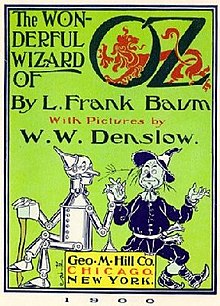
The Wonderful Wizard of Oz is an American children's novel written by author L. Frank Baum and illustrated by W. W. Denslow, originally published by the George M. Hill Company in Chicago on May 17, 1900. It has since been reprinted on numerous occasions, most often under the title The Wizard of Oz, which is the title of the popular 1902 Broadway musical as well as the iconic 1939 musical film adaptation.

沒有留言:
張貼留言