2016年1月10日 星期日

week 18 兒童文學

Term explanation
Bildungsroman

 is a literary genre that focuses on the psychological and moral growth of the protagonist from youth to adulthood (coming of age), in which character change is extremely important.

1.      Bildungsroman
2.      Initiation
3.      fairy tales
4.      nursery rhymes
5.      fables


Hansel and Gretel
   Once upon a time a very poor woodcutter lived in a tiny cottage in the forest with his two children, Hansel and Gretel. His second wife often ill-treated the children and was forever nagging the woodcutter.

   "There is not enough food in the house for us all. There are too many mouths to feed! We must get rid of the two brats," she declared. And she kept on trying to persuade her husband to abandon his children in the forest.

   "Take them miles from home, so far that they can never find their way back! Maybe someone will find them and give them a home." The downcast woodcutter didn't know what to do. Hansel who, one evening, had overheard his parents' conversation, comforted Gretel.

   "Don't worry! If they do leave us in the forest, we'll find the way home," he said. And slipping out of the house he filled his pockets with little white pebbles, then went back to bed.

   All night long, the woodcutter's wife harped on and on at her husband till, at dawn, he led Hansel and Gretel away into the forest. But as they went into the depths of the trees, Hansel dropped a little white pebble here and there on the mossy green ground. At a certain point, the two children found they really were alone: the woodcutter had plucked up enough courage to desert
them, had mumbled an excuse and was gone.

   Night fell but the woodcutter did not return. Gretel began to sob bitterly. Hansel too felt scared but he tried to hide his feelings and comfort his sister.

   "Don't cry, trust me! I swear I'll take you home even if Father doesn't come back for us!" Luckily the moon was full that night and Hansel waited till its cold light filtered through the trees.

   "Now give me your hand!" he said. "We'll get home safely, you'll see!" The tiny white pebbles gleamed in the moonlight, and the children found their way home. They crept through a half open window, without wakening their parents. Cold, tired but thankful to be home again, they slipped into bed.

   Next day, when their stepmother discovered that Hansel and Gretel had returned, she went into a rage. Stifling her anger in front of the children, she locked her bedroom door, reproaching her husband for failing to carry out her orders. The weak woodcutter protested, torn as he was between shame and fear of disobeying his cruel wife. The wicked stepmother kept Hansel and Gretel under lock and key all day with nothing for supper but a sip of water and some hard bread. All night, husband and wife quarreled, and when dawn came, the woodcutter led the children out into the forest.

   Hansel, however, had not eaten his bread, and as he walked through the trees, he left a trail of crumbs behind him to mark the way. But the little boy had forgotten about the hungry birds that lived in the forest. When they saw him, they flew along behind and in no time at all, had eaten all the crumbs. Again, with a lame excuse, the woodcutter left his two children by
themselves.

   "I've left a trail, like last time!" Hansel whispered to Gretel, consolingly. But when night fell, they saw to their horror, that all the crumbs had gone.

   "I'm frightened!" wept Gretel bitterly. "I'm cold and hungry and I want to go home!"

   "Don't be afraid. I'm here to look after you!" Hansel tried to encourage his sister, but he too shivered when he glimpsed frightening shadows and evil eyes around them in the darkness. All night the two children huddled together for warmth at the foot of a large tree.

   When dawn broke, they started to wander about the forest, seeking a path, but all hope soon faded. They were well and truly lost. On they walked and walked, till suddenly they came upon a strange cottage in the middle of a glade.

   "This is chocolate!" gasped Hansel as he broke a lump of plaster from the wall.

   "And this is icing!" exclaimed Gretel, putting another piece of wall in her mouth. Starving but delighted, the children began to eat pieces of candy broken off the cottage.

   "Isn't this delicious?" said Gretel, with her mouth full. She had never tasted anything so nice.

   "We'll stay here," Hansel declared, munching a bit of nougat. They were just about to try a piece of the biscuit door when it quietly swung open.

   "Well, well!" said an old woman, peering out with a crafty look. "And haven't you children a sweet tooth?"

   "Come in! Come in, you've nothing to fear!" went on the old woman. Unluckily for Hansel and Gretel, however, the sugar candy cottage belonged to an old witch, her trap for catching unwary victims. The two children had come to a really nasty place.

   "You're nothing but skin and bones!" said the witch, locking Hansel into a cage. I shall fatten you up and eat you!"

   "You can do the housework," she told Gretel grimly, "then I'll make a meal of you too!" As luck would have it, the witch had very bad eyesight, an when Gretel smeared butter on her glasses, she could see even less.

   "Let me feel your finger!" said the witch to Hansel every day to check if he was getting any fatter. Now, Gretel had brought her brother a chicken bone, and when the witch went to touch his finger, Hansel held out the bone.

   "You're still much too thin!" she complained. When will you become plump?" One day the witch grew tired of waiting.

   "Light the oven," she told Gretel. "We're going to have a tasty roasted boy today!" A little later, hungry and impatient, she went on: "Run and see if the oven is hot enough." Gretel returned, whimpering: "I can't tell if it is hot enough or not." Angrily, the witch screamed at the little girl: "Useless child! All right, I'll see for myself." But when the witch bent down to peer inside the oven and check the heat, Gretel gave her a tremendous push and slammed the oven door shut. The witch had come to a fit and proper end. Gretel ran to set her brother free and they made quite sure that the oven door was tightly shut behind the witch. Indeed, just to be on the safe side, they fastened it firmly with a large padlock. Then they stayed for several days to
eat some more of the house, till they discovered amongst the witch's belongings, a huge chocolate egg. Inside lay a casket of gold coins.

   "The witch is now burnt to a cinder," said Hansel, "so we'll take this treasure with us." They filled a large basket with food and set off into the forest to search for the way home. This time, luck was with them, and on the second day, they saw their father come out of the house towards them, weeping.

   "Your stepmother is dead. Come home with me now, my dear children!" The two children hugged the woodcutter.

   "Promise you'll never ever desert us again," said Gretel, throwing her arms round her father's neck. Hansel opened the casket.

   "Look, Father! We're rich now . . . You'll never have to chop wood again."

   And they all lived happily together ever after.(resolution)

The End

2016年1月6日 星期三

week 17 兒童文學

preview:

The secret gardon
he Secret Garden is a novel by Frances Hodgson Burnett. It was initially published in serial format starting in the autumn of 1910, and was first published in its entirety in 1911. It is now one of Burnett's most popular novels, and is considered to be a classic of English children's literature. Several stage and film adaptations have been produced.
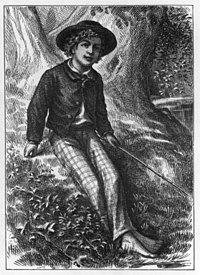
Tom Sawyer
 is the title character of the Mark Twain novel The Adventures of Tom Sawyer (1876). He appears in three other novels by Twain: Adventures of Huckleberry Finn (1884), Tom Sawyer Abroad (1894), and Tom Sawyer, Detective (1896).
Sawyer also appears in at least three unfinished Twain works, Huck and Tom Among the Indians, Schoolhouse Hill and Tom Sawyer's Conspiracy. While all three uncompleted works were posthumously published, only Tom Sawyer's Conspiracy has a complete plot, as Twain abandoned the other two works after finishing only a few chapters.

Tom Sawyer 1876 frontispiece.jpg

Harry Potter

Harry Potter is a series of seven fantasy novels written by British author J. K. Rowling. The series chronicles the life of a young wizard, Harry Potter and his friends Hermione Grangerand Ron Weasley, all of whom are students at Hogwarts School of Witchcraft and Wizardry. The main story arc concerns Harry's struggle to kill the Dark wizard Lord Voldemort, who aims to become immortal, overthrow the Ministry of Magic, subjugate non-magic people and destroy anyone who stands in his way.

J. K. Rowling and Robert Galbraith, is a British novelist, screenwriter and film producer best known as the author of the Harry Potter fantasy series. The books have gained worldwide attention, won multiple awards, and sold more than 400 million copies. They have become the best-selling book series in history and been the basis for a series of films which is the second highest-grossing film series in history. Rowling had overall approval on the scripts[6] and maintained creative control by serving as a producer on the final instalment.

J. K. Rowling 2010.jpg

divergent 分歧者
Divergent is a 2014 American science fiction action film directed by Neil Burger, based on the novel of the same name by Veronica Roth. The film is the first installment in The Divergent Series and was produced by Lucy Fisher, Pouya Shabazian, and Douglas Wick, with a screenplay by Evan Daugherty and Vanessa Taylor.

Lead characters Tris and Four stand above a futuristic Chicago.

hunger game 飢餓遊戲
The Hunger Games is a series of three adventure novels written by the American author Suzanne Collins. The series is set in The Hunger Games universe, and follows young characters Katniss Everdeen and Peeta Mellark.

The story takes place in a dystopian and post-apocalyptic Chicago where people are divided into distinct factions based on human virtues. 

HungerGamesPoster.jpg

Detective film 

Detective fiction is a subgenre of crime fiction and mystery fiction in which an investigator or a detective—either professional or amateur—investigates a crime, often murder.

Beginning of detective fiction

In Ancient literature

Some scholars have suggested that certain ancient and religious texts bear similarities to what would later be called detective fiction. In the Old Testament story of Susanna and the Elders (the Protestant Bible locates this story within the apocrypha), the account told by two witnesses breaks down when Daniel cross-examines them. 

In Chinese literature


Gong'an fiction (公案小说, literally:"case records of a public law court")is the earliest known genre of Chinese detective fiction.
Some well known stories include the Yuan Dynasty story Circle of Chalk (Chinese:灰闌記), the Ming Dynasty story collection Bao Gong An (Chinese:包公案) and the 18th century Di Gong An (Chinese:狄公案) story collection. The latter was translated into English as Celebrated Cases of Judge Dee by Dutch sinologist Robert Van Gulik, who then used the style and characters to write an original Judge Dee series.

Sir Arthur Ignatius Conan Doyle KStJ, DL (22 May 1859 – 7 July 1930) was a Scottish[1] writer and physician, most noted for his fictional stories about the detective Sherlock Holmes, which are generally considered milestones in the field of crime fiction.
He is also known for writing the fictional adventures of a second character he invented, Professor Challenger, and for popularising the mystery of the Mary Celeste. He was a prolific writer whose other works include fantasy and science fiction stories, plays, romances, poetry, non-fiction and historical novels.

Arthur Conany Doyle by Walter Benington, 1914.png

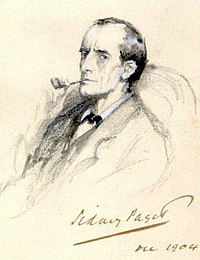
Sherlock Holmes  is a fictional character created by British author and physician Sir Arthur Conan Doyle. A London-based "consulting detective" whose abilities border on the fantastic, Holmes is known for his astute logical reasoning, his ability to adopt almost any disguise, and his use of forensic scienceto solve difficult cases.
Sherlock Holmes Portrait Paget.jpg

Arsène Lupin is a fictional gentleman thief and master of disguise created by French writer Maurice Leblanc.
Lupin was featured in 19 novels and 36 short stories by Leblanc, with the short stories collected into book form for a total of 24 books. The first story, "The Arrest of Arsène Lupin", was published in the magazine Je sais tout on 15 July 1905.
The character has also appeared in a number of books from other writers as well as numerous film, television, stage play, and comic book adaptations.

Arsène Lupin and Sherlock Holmes

Leblanc introduced Sherlock Holmes to Lupin in the short story "Sherlock Holmes Arrives Too Late" in Je sais tout No. 17, 15 June 1906. In it, an aged Holmes meets a young Lupin for the first time. After legal objections from Conan Doyle, the name was changed to "Herlock Sholmes" when the story was collected in book form in Volume 1.
Sholmes returned in two more stories collected in Volume 2, "Arsène Lupin contre Herlock Sholmes", and then in a guest-starring role in the battle for the secret of the Hollow Needle in L'Aiguille creuse. Arsène Lupin contre Herlock Sholmes was published in the United States in 1910 under the title "The Blonde Lady" which used the name "Holmlock Shears" for Sherlock Holmes, and "Wilson" for Watson.

Samuel Ullman (April 13, 1840 – March 21, 1924) was an American businessman, poet, humanitarian. He is best known today for his poem Youth which was a favorite of General Douglas MacArthur. The poem was on the wall of MacArthur's office in Tokyo when he became Supreme Allied Commander in Japan. In addition, MacArthur often quoted from the poem in his speeches, leading to it becoming better known in Japan than in the United States.
Born in 1840 at Hechingen, Hohenzollern to Jewish parents, Ullman immigrated with his family to America to escape discrimination at the age of eleven. The Ullman family settled in Port Gibson, Mississippi. After briefly serving in the Confederate Army, he became a resident of Natchez, Mississippi. There, Ullman married, started a business, served as a city alderman, and was a member of the local board of education.
In 1884, Ullman moved to the young city of Birmingham, Alabama, and was immediately placed on the city's first board of education.
Youth
Youth
by Samuel Ullman
Youth is not a time of life; it is a state of mind; it is not a matter of rosy cheeks, red lips and supple knees; it is a matter of the will, a quality of the imagination, a vigor of the emotions; it is the freshness of the deep springs of life.
Youth means a temperamental predominance of courage over timidity of the appetite, for adventure over the love of ease. This often exists in a man of sixty more than a boy of twenty. Nobody grows old merely by a number of years. We grow old by deserting our ideals.
Years may wrinkle the skin, but to give up enthusiasm wrinkles the soul. Worry, fear, self-distrust bows the heart and turns the spirit back to dust.
Whether sixty or sixteen, there is in every human being’s heart the lure of wonder, the unfailing child-like appetite of what’s next, and the joy of the game of living. In the center of your heart and my heart there is a wireless station; so long as it receives messages of beauty, hope, cheer, courage and power from men and from the Infinite, so long are you young.
When the aerials are down, and your spirit is covered with snows of cynicism and the ice of pessimism, then you are grown old, even at twenty, but as long as your aerials are up, to catch the waves of optimism, there is hope you may die young at eighty.

is a 1951 novel by J. D. Salinger.A controversial novel originally published for adults, it has since become popular with adolescent readers for its themes of teenage angst and alienation. It has been translated into almost all of the world's major languages.Around 250,000 copies are sold each year with total sales of more than 65 million books.The novel's protagonist Holden Caulfield has become an icon for teenage rebellion. The novel also deals with complex issues of identity, belonging, loss, and connection.
Rye catcher.jpg


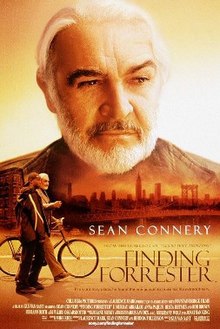
Finding Forrester is a 2000 American drama film written by Mike Rich and directed by Gus Van Sant. An African-American teenager, Jamal Wallace (Rob Brown), is invited to attend a prestigious private high school. By chance, Jamal befriends a reclusive writer, William Forrester (Sean Connery), through whom he refines his talent for writing and comes to terms with his identity.Anna Paquin, F. Murray Abraham, Michael Pitt, April Grace and Busta Rhymes star in supporting roles.
Although the film is not based on a true story, film critics have compared the character portrayed by Connery with real life writer J.D. Salinger. Connery later acknowledged that the inspiration for his role was indeed Salinger

Jerome David Salinger was an American writer who won acclaim early in life. He led a very private life for more than a half-century. He published his final original work in 1965 and gave his last interview in 1980.
JD Salinger.jpg

Movie
Finding forrester.jpg


Adventures of Huckleberry Finn (or, in more recent editions, The Adventures of Huckleberry Finn) is a novel by Mark Twain, first published in the United Kingdom in December 1884 and in the United States in February 1885. Commonly named among theGreat American Novels, the work is among the first in major American literature to be written throughout in vernacular English, characterized by local color regionalism. It is told in the first personby Huckleberry "Huck" Finn, a friend of Tom Sawyer and narrator of two other Twain novels (Tom Sawyer Abroad and Tom Sawyer, Detective). It is a direct sequel to The Adventures of Tom Sawyer.
Mark Twain's Adventures of Huckleberry Finn summary

.


Spare the rod , and spoil the child.

Samuel Ulmes